Injured Before a Race? How to Legally Get Your Entry Fee Money Back
Getting injured right before a marathon or half marathon is a runner's nightmare. Learn how to handle the situation medically, how race cancellation insurance works, and how to safely resell your bib.
An injury in the final weeks of marathon or half marathon training is a runner's ultimate nightmare. Months of demanding workouts, invested time, energy, and paid entry fees can vanish in an instant due to a stress fracture, torn muscle, or acute illness. In this situation, runners often find themselves under immense psychological pressure and make impulsive decisions. The good news is that an injury does not have to mean an automatic financial loss. By choosing the correct and legal procedure in compliance with the event organizer's rules, you can recover your funds while protecting your long-term health.
📊 Medical Triage: When is Starting an Absolute Taboo?
Many runners make the critical mistake of trying to finish a race through severe pain at all costs, often under the influence of strong painkillers. Ignoring your body's warning signs might get you to the finish line, but the resulting structural damage can sideline you from running for months or even years. From a medical standpoint, starting is strictly prohibited in the case of:
- Acute Inflammation and Fevers: Running with a viral or bacterial infection drastically increases the risk of myocarditis (inflammation of the heart muscle), which can have fatal consequences.
- Structural Tissue Damage: Suspected stress fractures, severe ankle sprains, or partial tendon and muscle tears will turn into complete ruptures under the stress of a race.
- Sports Physician's Recommendation: If a professional examination (such as an ultrasound or MRI) reveals a pathology, the race must take a back seat. Missing one starting line is just a brief pause on your lifelong running journey.
❌ How Does Entry Fee Cancellation Work with European Organizers?
Once the final decision not to start is made, your first step must be analyzing the terms and conditions of the specific race. European event organizers approach refunds and cancellations in three distinct ways:
- Official Cancellation Insurance: If you paid for cancellation insurance during registration (either directly with the organizer or through a partner insurance company like Allianz or ERV), you are entitled to a refund of up to 100% of the entry fee. However, this is conditional on submitting an official medical certificate clearly confirming your inability to compete on the race date.
- Internal Deferral Systems: Major international marathons (such as Berlin or London) do not refund entry fees but allow you to defer your entry right to the following year upon submitting documentation or paying a fee. This ensures you do not have to go through the risky lottery process again.
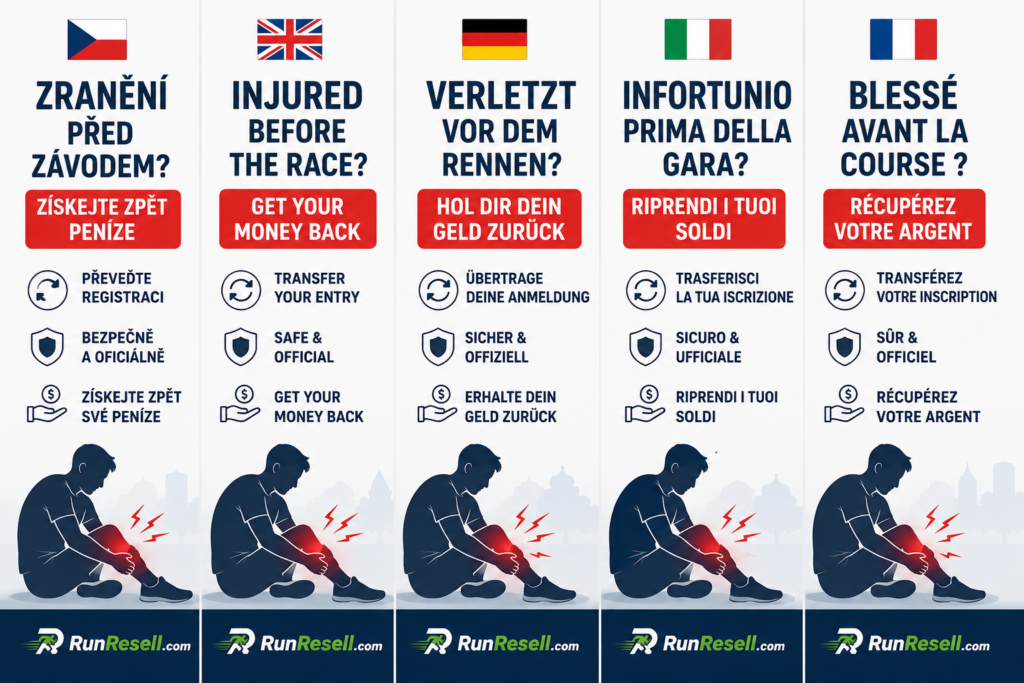
- Registration Transfer to Another Runner (Rebooking): An increasing number of European races and series (including SuperHalfs) offer an official transfer option. The original owner cancels their participation, and the system generates a unique registration code (voucher) that can be legally passed on to a replacement runner.
🛠️ How to Safely Transfer a Registration on the Secondary Market
If the organizer does not provide a direct refund but allows an official registration transfer (Rebooking), the secondary market is the only way to avoid losing your money. If the race is sold out, last-minute demand is enormous, and you can sell your starting slot for full or near-full face value.
However, runners under time pressure and stress from an injury become easy targets for internet scammers in unverified Facebook groups and discussion forums. Attackers often fake interest in buying, send an AI-edited screenshot showing a sent bank or Revolut payment, and demand immediate transfer of the registration code. Once they obtain the code, they redeem it and cut off communication.
Consequently, the most secure solution is to process the registration resale through the specialized RunResell marketplace. Our platform operates on a secure financial escrow principle (Escrow). The buyer transfers the ticket price to a neutral platform account, where the funds are safely frozen. As an injured runner, you can then complete the official transfer in the organizer's system and provide the generated code without stress. The funds are released to you from escrow immediately after the new runner successfully completes registration under their name. This model completely eliminates financial risk, allowing you to focus 100% on your recovery and healing.