Marathon Pace Calculator: Calculate Target Finish Time from Running Pace
Marathon pace calculator. Convert target time and pace for a marathon.
🏃♂️ Marathon Pace Calculator – Speed Calculation and Finish Time Planning
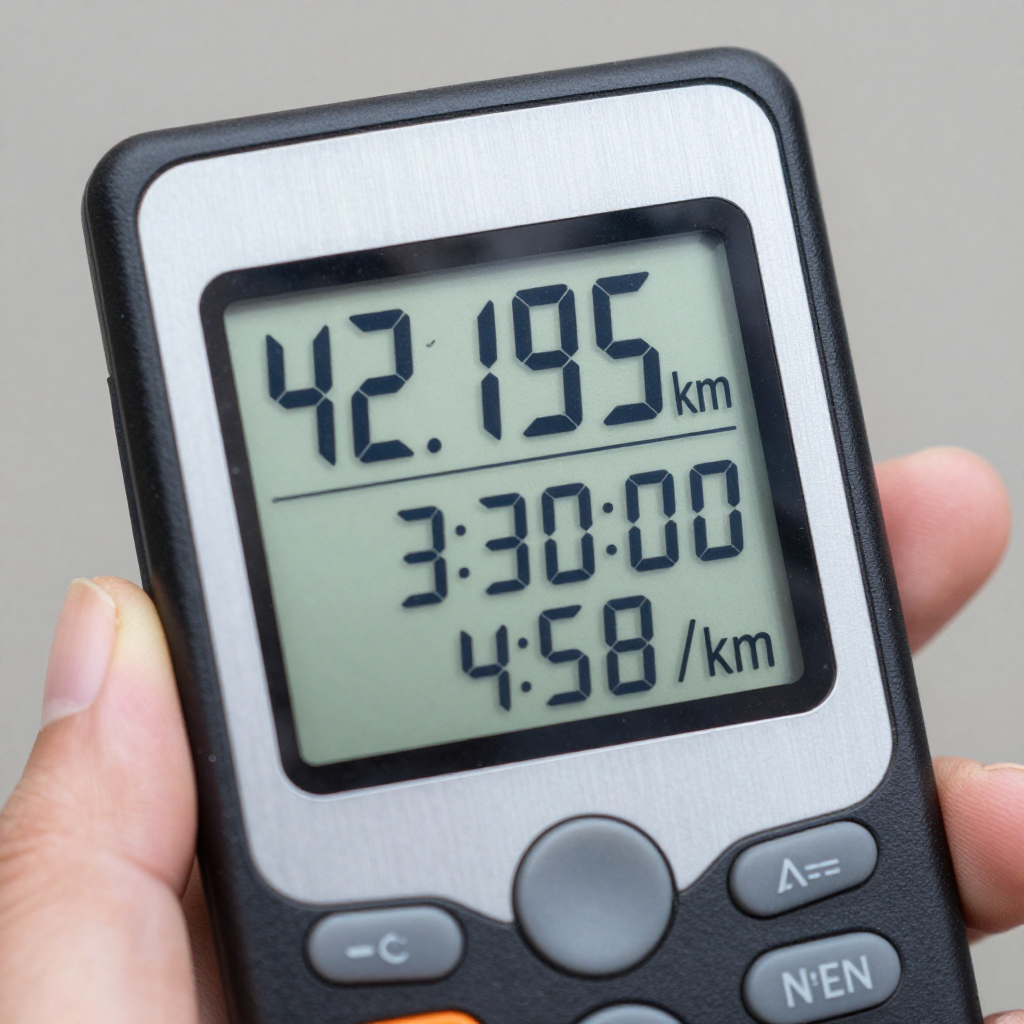
The Marathon Pace Calculator is one of the most critical tools when preparing for the king of endurance distances. A correctly chosen strategy significantly impacts the final result and determines whether you finish the race in good shape. Within a single, streamlined interface, this calculator helps you find out what average pace you must maintain across the entire 42.195 km distance to achieve your dream finish time, or conversely, computes the expected finish time based on your selected pace.
Within one single table, you can easily switch the calculation method depending on the input metrics you currently have at hand. Everything is handled in one place without the need for complex manual conversions.
🧮 How the Calculator Computes: Two Calculation Methods in One Table
The calculator algorithm works strictly with the official marathon distance of 42,195 meters. Simply open the dropdown menu, select your preferred calculation method, and input the values:
Option 1: Calculation Method – By Target Time
Use this option if you have a clear time goal (e.g., breaking the 4-hour mark) and need to find out the exact pace required for your training.
- Hours: The full hours of your target finish time (e.g., 4 for a time of 4:10:00).
- Minutes: The minutes of your time (e.g., 10 for a time of 4:10:00).
- Seconds: The seconds of your time (if there are no seconds, enter 0).
- Result: The calculator computes exactly how many minutes and seconds you must run on average per single kilometer. For example, to finish in exactly 4:00:00, your average marathon pace is approximately 5:41 min/km.
Option 2: Calculation Method – By Pace
Choose this option if you know your stable pace from long endurance training runs and want to see what finish time that specific pace will yield on a marathon course.
- Pace – minutes: The minutes of your pace (e.g., 5 for a pace of 5:30 min/km).
- Pace – seconds: The seconds of your pace (e.g., 30 for a pace of 5:30 min/km).
- Result: The script multiplies the entered pace by the entire length of the course and instantly displays your expected total marathon time in a hours, minutes, and seconds format.
Results are guidelines for running planning purposes only. It does not replace medical or coaching advice.
📈 Why Is a Steady Marathon Pace So Important?
Maintaining an even and steady pace is the single most important factor for a successful marathon. The human body stores a limited amount of glycogen (carbohydrates) in the liver and muscles, which under marathon intensity lasts for roughly 30 to 32 kilometers. If you run the beginning of the race even just a few seconds per kilometer faster than your calculated calculator pace, your body will burn through glycogen much earlier. This leads to a drastic slowdown in the final kilometers, severe cramping, and hitting the infamous marathon wall.
A correctly chosen pace allows you to manage energy efficiently, tap into fat stores for fuel, and maintain a stable performance throughout the entire race.
⚠️ RunResell Advice – Split Planning and Reality on the Course
In our RunResell.com secure registration resale platform community, we frequently connect with runners who had to sell their hard-earned entries due to overuse injuries. Often, they got injured because they tried to strictly run nothing but their target marathon pace during training.
The mathematical calculation from a calculator presents a theoretical average assuming a constant speed on a perfectly flat surface. In a real race (such as the undulating city marathons in New York or hilly courses), you must account for elevation gain, weather, wind, and also starter crowd density in the opening kilometers where the crowd prevents you from establishing an ideal rhythm.
When preparing for your race, use the calculator not just to find a single number, but to map out estimate splits for every 5 kilometers. Build your race strategy by running the first half 5 to 10 seconds per kilometer slower than what the calculator displayed. You will then utilize the saved energy and glycogen in the second half of the race, right when other runners start slowing down heavily due to fatigue.