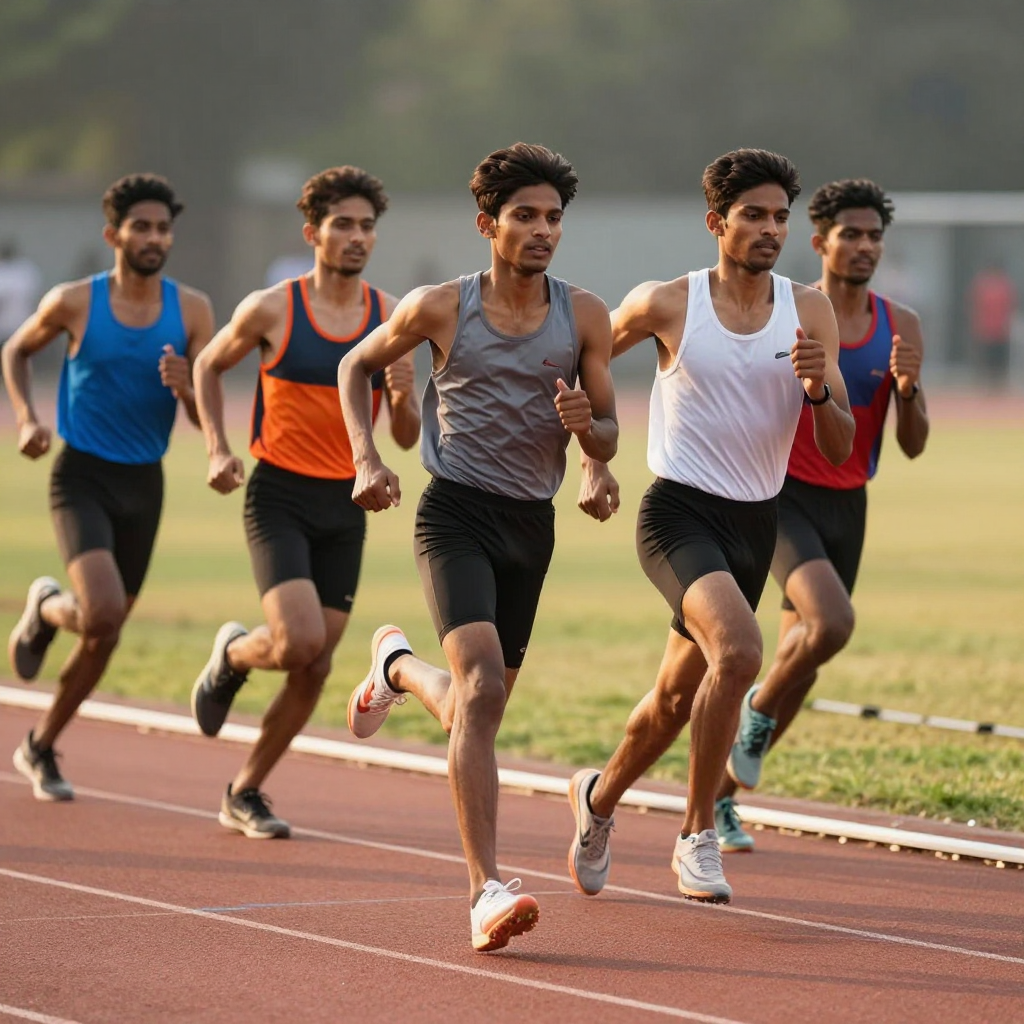
Half Marathon Time Prediction Calculator: Estimate Performance from Another Distance
Half marathon time prediction calculator. Estimate 21.1 km time from 5k or 10k.
🏃♂️ Half Marathon Time Prediction Calculator – Performance and Strategy Planning
The Half Marathon Time Prediction Calculator helps you accurately estimate the finish time you can achieve on a 21.0975 km course. The calculation is based on your real-world performance on other running distances and uses proven prediction models trusted by running coaches and sports scientists. This tool serves as a strategic guide for setting realistic goals, determining correct training paces, and protecting your health from overtraining injuries caused by overambitious targets.
The primary advantage of this calculator is its simple interface. Within a single table, you can enter data from a recent workout or race on shorter or longer distances and instantly receive a detailed calculation for the half marathon distance.
🧮 How the Calculator Computes with Your Data
The interface is designed for direct data entry without the need for complex manual conversions to seconds. You input the following values into the form:
- Distance (km): The length of the run or race from which you want to make the prediction (e.g., 5 or 10).
- Hours: The full hours of your finish time (e.g., 0 for shorter runs, or 1 and more for longer distances).
- Minutes: The minutes of your time (e.g., 45 for a time of 45:30).
- Seconds: The seconds of your time (if there are no seconds, enter 0).
After clicking the Calculate button, the algorithm compares your achieved performance with mathematical models such as the internationally recognized Riegel formula. This formula accounts for the natural decline in speed as distance increases, expressed through a fatigue coefficient. The output shows your estimated half marathon finish time and the average target pace required to achieve it.
Results are guidelines for running planning purposes only. It does not replace medical or coaching advice.
📈 How Accurate Is the Mathematical Prediction and What Affects It?
The Riegel formula provides a highly reliable estimation, provided you have completed appropriate endurance training for the target distance. The precision of the calculation in real-world practice is influenced by several factors:
- Choice of Input Distance: You will get the most accurate estimation if you use a recent race on a similar distance as input, such as 10 km or 15 km. If you enter a time from an extremely short distance (e.g., 1 km), the half marathon prediction will be less accurate because raw speed capacity does not reflect aerobic endurance.
- Training Specifics: If you specialize purely in short intervals and lack long continuous runs, your actual half marathon pace will be slower than the mathematical estimation.
- External Conditions: The calculator models an ideal scenario. Real time on the course will be affected by the profile and elevation gain of the specific race, weather, headwinds, hydration, and proper pacing.
⚠️ RunResell Advice – The Pitfalls of Blind Trust in Mathematical Models
In our RunResell.com secure registration resale platform community, we connect daily with runners who were forced to sell their entries for a sold-out half marathon. Analyzing their training history often reveals the same issue: blind trust in the time calculated by an online calculator, followed by severe overtraining.
Many amateur runners enter their best 5K time into the calculator and take the resulting half marathon prediction as dogma. They immediately start training at the exact pace the script computed, without their muscles, tendons, and cardiovascular system being ready for an endurance load lasting over an hour and a half. The result of this sudden overload is chronic Achilles tendonitis, knee pain, or stress fractures right before the starting gun.
Treat the prediction result as a smart and achievable potential, not a guaranteed time. Build your race strategy with respect for the 21 km distance. Run the first half of the race 5 to 10 seconds per kilometer slower than recommended by the calculator, and use the saved energy to increase your pace in the final third of the course.