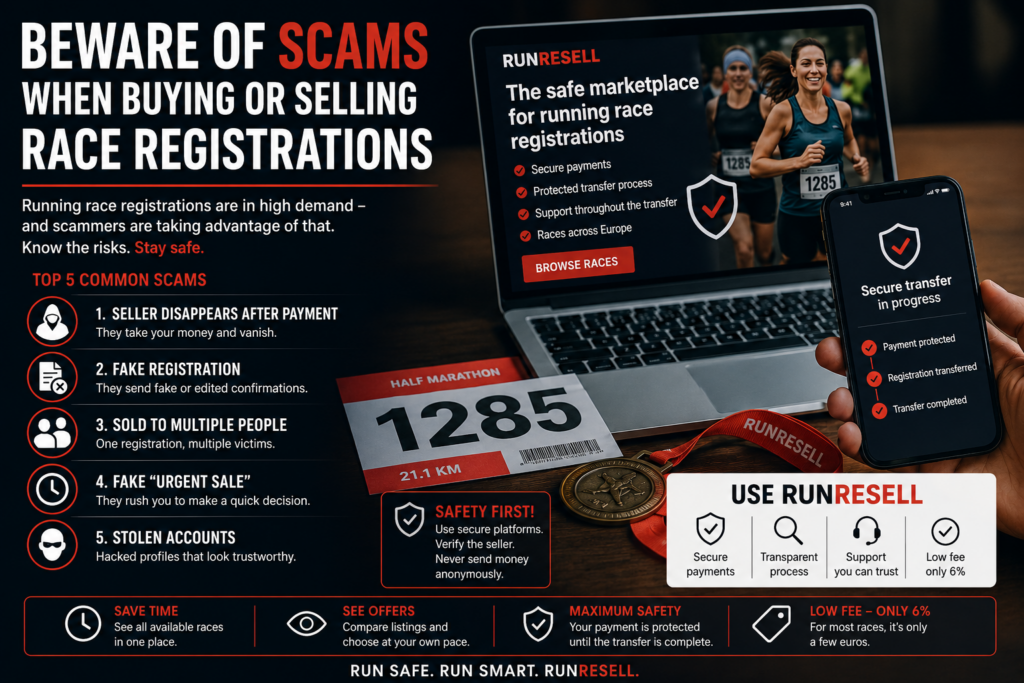
Beware of Ticket Scams in Running Race Registrations: Complete Safety Guide
Online running marketplace groups and social media are flooded with registration scammers. Learn what tricks they use across European races, how risks differ between digital codes and email transfers, and how to buy safely.
Online community groups, discussion forums, and social media platforms are heavily flooded with registration resale offers throughout the European running season. As the popularity of major marathons and half marathons grows dramatically, the secondary market has become a primary target for organized scammers. Many runners look for last-minute registration transfers under emotional stress, a vulnerability that attackers masterfully exploit. Since every European race organizer uses a different transfer method – ranging from fully automated platforms to manual transfers via email support – you must understand modern cyber-fraud methods to protect your money and personal data.
📊 Why Is Unofficial Registration Resale a Major Risk?
When buying "peer-to-peer" through social media comments, you enter a transaction that completely lacks safety mechanisms. The main risks of anonymous buying include:
- No identity verification: Social media profiles can be created in a few minutes or easily stolen from real users.
- No product inspection: Before sending a payment, you have no technical means to verify whether the seller actually owns the registration in the official race system and whether it is still valid.
- Advance payment without guarantees: Transactions rely on absolute trust; the buyer sends a non-refundable amount and hopes the seller will provide access to the registration.
❌ Most Common Types of Scams in the Running Secondary Market
1. Ghosting after quick payment
The most common scenario where the attacker responds to a runner's request in a discussion forum. They demand immediate payment via bank transfer, Revolut link, or PayPal "Friends & Family." Once the money hits their account, the attacker cuts off all communication, blocks you, and deletes the original listing or profile.
2. Fake PDF confirmations and screenshots
Scammers frequently do not own any entry slots. Instead, they use digitally altered email screenshots, fake payment receipts, or modified PDF documents from previous years. At first glance, the text and visuals look perfectly legitimate, but the included QR code or registration number is completely fabricated.
3. Multiple resales of a single transfer code or email confirmation
If a race uses an automatically generated discount code (voucher) for transfers or requires communication with support from a specific email address, scammers can easily exploit this. They sell the exact same transfer code or email screenshot independently to several different buyers. The first runner to enter the code into the official system or successfully complete the transfer with support gets the entry. The remaining runners only discover the fraud when the system displays an error or even later at the race Expo.
4. Psychological pressure and FOMO exploitation
Attackers are skilled social engineers. They create artificial time pressure and stress using phrases like: "I have five other buyers; whoever pays first gets the entry." Under the fear of missing out on a sold-out race (the FOMO effect), buyers act impulsively, ignore warnings, and transfer money without verification.
👕 How Do Risks Differ by Race Transfer Systems?
Different event organizers in Europe approach transfers differently, which changes the scammers' tactics:
- Automated Systems (Codes / Vouchers): The original owner generates a code that cancels their participation and allows the new runner to register for 0 EUR. Scammers here most often fake the text codes themselves or sell one code to multiple people.
- Manual Transfer via Email (Customer Support): The organizer requires the original owner to write an email to support with the new runner's details. Here, scammers send a fake screenshot of an email allegedly sent to support, when in reality it was never sent or was deleted right after taking the screenshot.
🛠️ How to Safely Buy a Starting Slot Online?
If you decide to risk buying outside specialized platforms, follow this strict procedure:
1. Demand proof of identity: Ask for an unedited screen recording from their official race profile, clearly showing their name and active order history.
2. Verify the profile and communication: Check the social media account's history. Newly created profiles, accounts with no running history, or communication with strange grammar (often from online translators) are clear indicators of fraud.
3. Use a secure marketplace: The most effective solution is to avoid risky chats altogether and buy exclusively through specialized platforms like RunResell, which operate across Europe and use a secure Escrow system. Funds are released to the seller only after the registration transfer is officially confirmed and approved in the event organizer's official database.
2. What to Do If You Have Been Scammed?
If you have fallen victim to a scam, you must act immediately to maximize the chances of recovering your money:
- Secure the evidence: Take screenshots of the entire conversation, save the attacker's profile ID, bank transaction receipt, and all related emails.
- Contact your bank: Ask your bank for a chargeback or a formal transaction dispute. While instant transfers are harder to recover, the bank can report and flag the fraudster's account.
- File a police report: Cyber fraud is a criminal offense. Even if your individual financial loss is low, police aggregate losses from multiple victims across different countries, turning it into an international organized crime investigation.